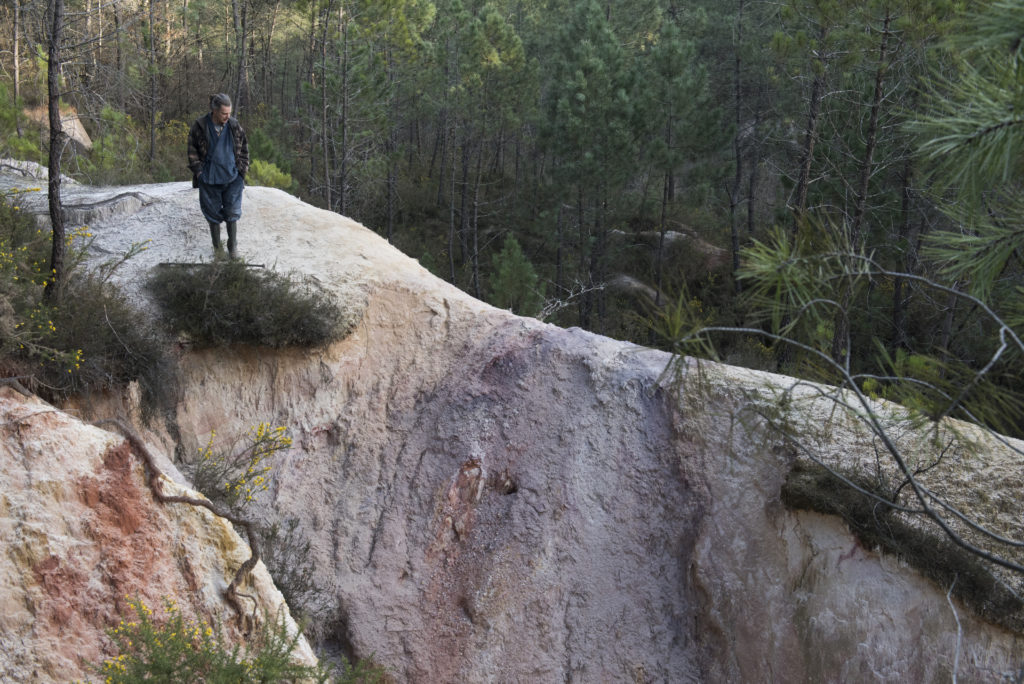
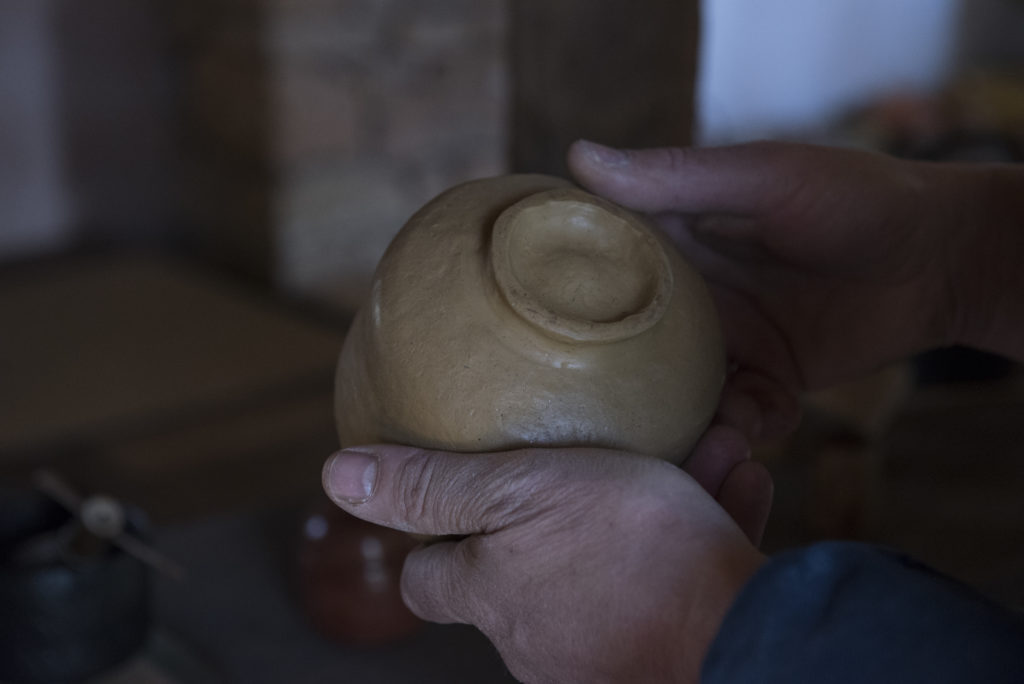
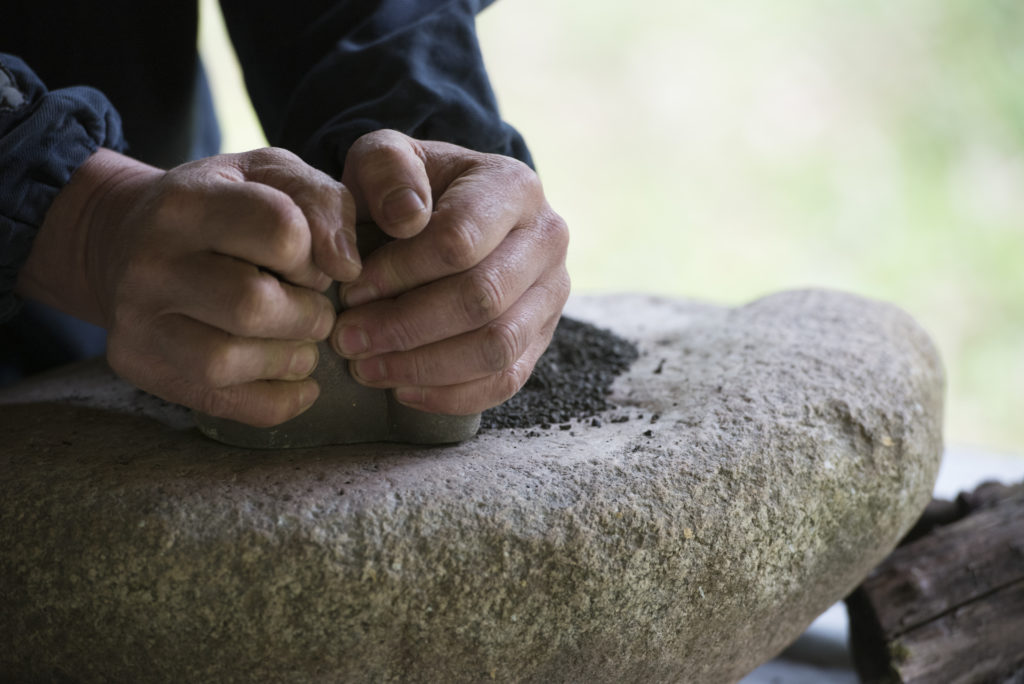
It is in the south-west of France, in Dordogne, in the heart of a forest, that Emmanuel Alexia sets up his workshop and builds his clay kilns. During his walks along the banks of ponds, on the edge of slopes, near springs, in mines and quarries, he collects clays and minerals. The clay, patiently chosen, is filtered and prepared by himself. By simple and successive finger pressures, he then shapes his bowls from a single ball of clay, without adding or removing anything. The stones and rocks are ground by hand on granite millstones, which come from a mountain torrent in the Pyrenees called l’Ourse (female bear). The powders obtained are then mixed according to formulas that he takes care to forget in order to constitute the covers that will be metamorphosed by fire.
By simple and successive finger pressures, he then shapes his bowls from a single ball of clay, without adding anything.
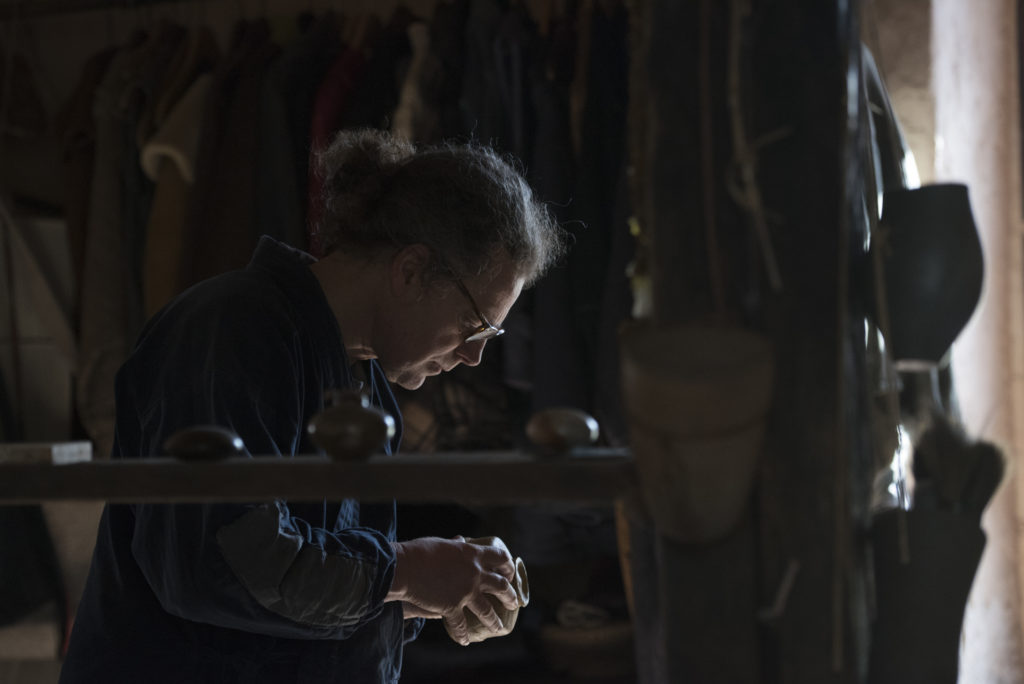
The wood or charcoal firings that he carries out without any measuring tool are guided by the knowledge acquired during all these years spent observing the transformations of mineral materials by fire; the fusion of earth and glazes. Accelerator of erosion and abrasion, “triturator” of materials, condenser of energies, Emmanuel Alexia, lives the creation of a bowl as a new experience without any preliminary test.
On the scale of his two hands joined together, this receptacle becomes, in other hands, the place of recollection and sharing. In ceramic art, the “chawan” ideally embodies this triad of contemplation-action-meditation in which the five senses and the mind are invited to create and appreciate the work…
When one first discovers Emmanuel Alexia’s work, a question comes to mind: why, in a country where the tradition of “cha no yu” is still not very widespread, a man who grew up far from Japanese culture, one day decides to dedicate his life to the creation of ceramics for the tea ceremony. Undoubtedly, more than a decade of working with master glassmakers to create stained glass windows in Romanesque churches and Gothic cathedrals will have awakened a passion for the arts of fire, the magic of the transformation of materials and the intimate link that a manual activity can have with a spiritual heritage.
In ceramic art, the “chawan” ideally embodies this triad of contemplation-action-meditation in which the five senses and the mind are invited to create and appreciate the work…
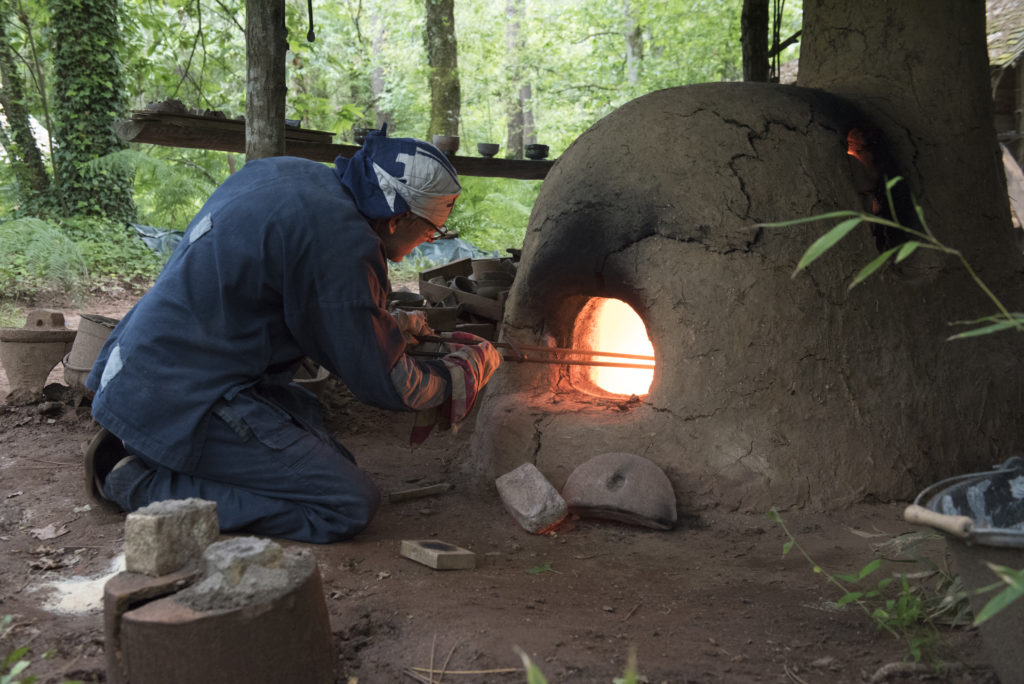
The wood or charcoal firings that he carries out without any measuring tool are guided by the knowledge acquired during all these years spent observing the transformations of mineral materials by fire; the fusion of earth and glazes.
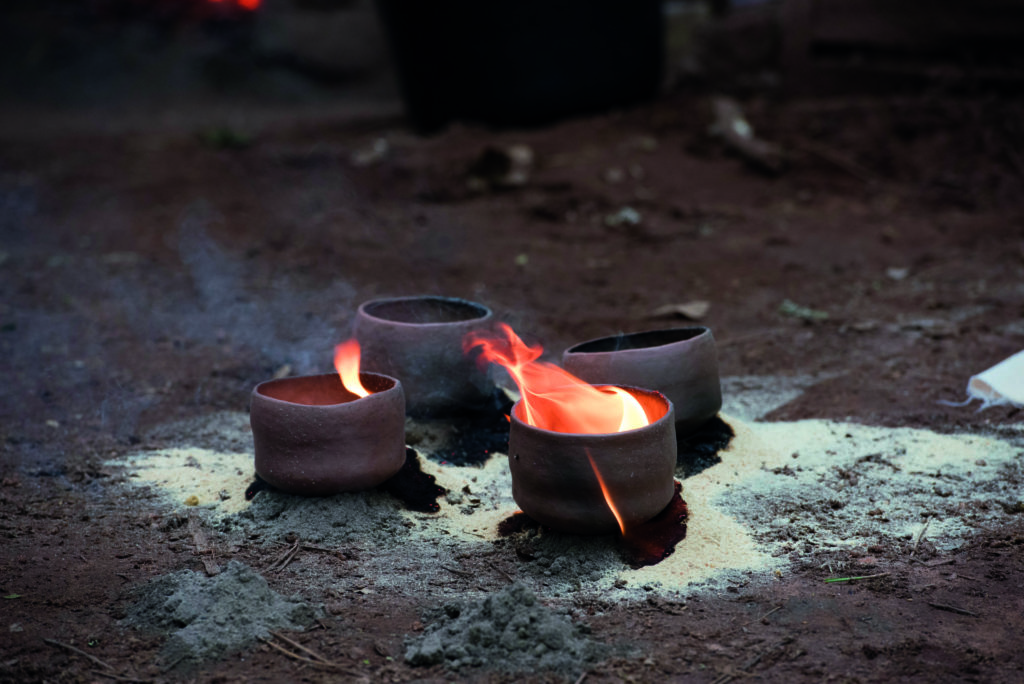
His encounters in Europe and Japan with women and men who practice the Way of Tea have nourished his choice of creative path. Emmanuel Alexia’s affinities and his taste for certain aspects of Japanese culture do not allow us to forget that his daily practice of ceramics is universal, sensory, intuitive and reasoned. The sky he contemplates, the clay he gathers and shapes, the fire he conducts and tames, are neither Eastern nor Western…
Emmanuel Alexia knows himself and lives as a being of Nature. His works evoke rain on the stones of the road, the weave of dead leaves, forests in the twilight, snowy landscapes, stormy skies, the skin of meteorites, myriads of stars and galactic faraway places… Fire, earth, water and air are his travelling companions. His main meditation, the creation of bowls…
Text born from dialogues between Claire Landais and Emmanuel Alexia
Photos Sarah Robine
The text and photos of this article are taken from the book Au cœur de la forêt published in 2019 on the occasion of an exhibition of the artist at the Nomura Art Museum in Kyoto (Japan)
Recent exhibitions
– Cha-no-yu : A Ceramic Sacred Space, Cavin-Morris Gallery, New-York. 2021
– Kanreki Chawans, gallery Le sentiment des choses, Paris. 2020
– A Sculptural Universe, Philadelphia. 2020
– Exhibition “Au cœur de la forêt”, Nomura Art Museum, Kyoto, Japan. 2019
– Hōō Kaikan, Tamba-Sasayama. 2019
– Temple Shörei-in, Enkakuji, Kamakura, Japan. 2017
– Dojima Gallery Osaka, Japan. 2009